1. Check the thermostat
Make sure the thermostat is set to Cool and the set point is a few degrees below the room temperature. Set the fan to Auto, not On. With the fan on On, the blower keeps running between cooling cycles and pushes room-temperature air through the vents, which can feel like the AC isn't working.
If the screen is blank, replace the batteries if it uses them. A blank screen on a thermostat without batteries can point to a power problem at the system, such as a tripped breaker or a float switch that shut the system off because the condensate drain is clogged.
Smart thermostats can also be holding an eco, away or scheduled temperature. Check for a hold or schedule before assuming the equipment is at fault.
2. Check the breakers and the outdoor unit
A central air conditioner has two parts: the indoor unit (a furnace or air handler) and the outdoor unit. Both need power. In your electrical panel, look for a tripped breaker labeled AC, condenser, furnace or air handler. Reset a tripped breaker once. If it trips again, leave it off and call, because a breaker that keeps tripping is protecting you from an electrical fault.
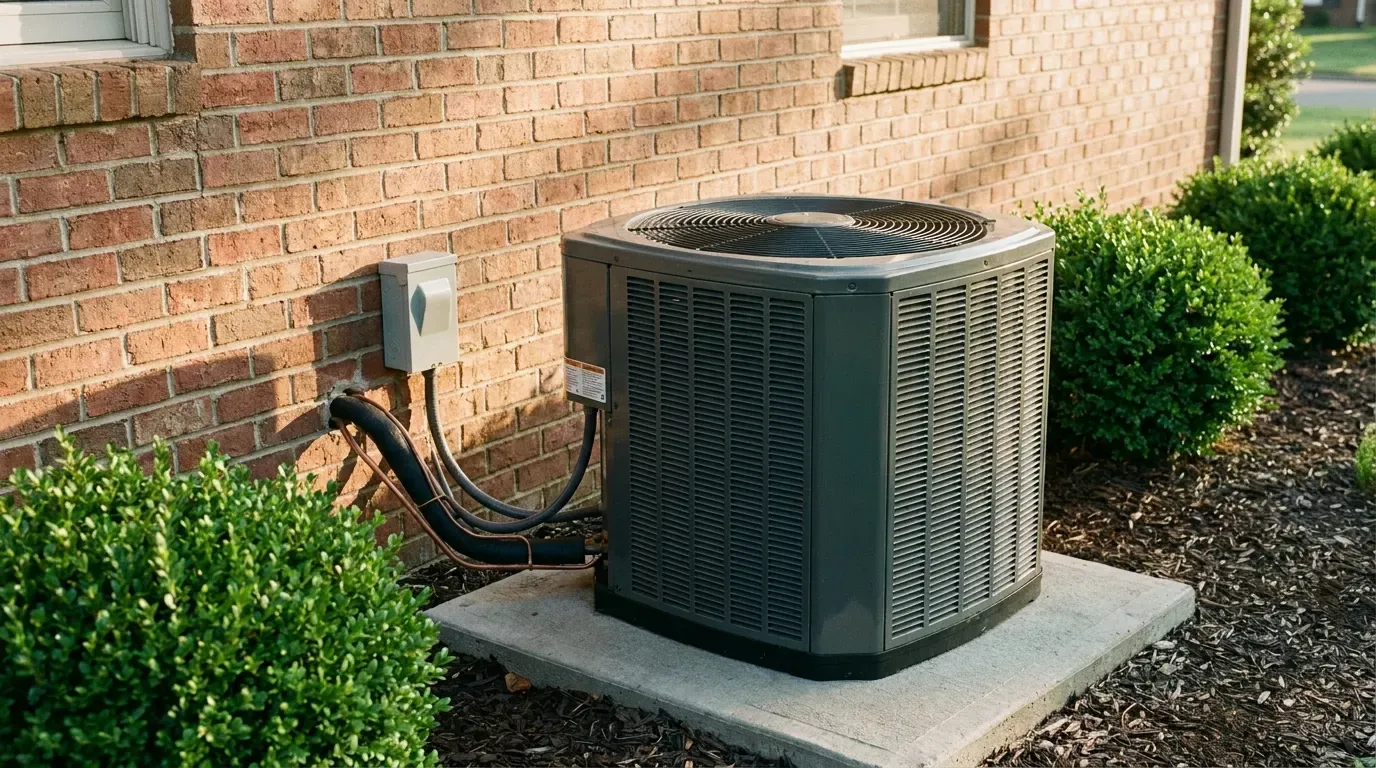
Next, go outside while the system is calling for cooling. The outdoor fan should be spinning and you should hear the compressor running. If the indoor blower runs but the outdoor unit is silent, or it hums without the fan turning, turn the system off at the thermostat. A failed capacitor or contactor is a common cause, and running the compressor in that state can damage it.
3. Check the filter and airflow
Restricted airflow is one of the most common reasons an AC stops cooling well. A clogged filter cuts the air moving across the indoor coil, and with too little warm air passing over it, the coil can drop below freezing and ice over.
- Pull the filter and hold it up to a light. If you can't see light through it, replace it with the same size and type. The size is printed on the frame.
- Keep supply vents open in the rooms you use. Closing too many vents can restrict airflow on a central system.
- Keep return grilles, the larger vents that pull air back to the system, clear of furniture, rugs and curtains.
- Outside, clear leaves, grass clippings and stored items about two feet back from the unit so it can move air. Don't bend the coil fins or open the unit's panels.
4. If you see ice
Ice on the copper lines at the outdoor unit or on the indoor coil means the coil is running too cold. Low airflow and low refrigerant are the usual reasons. Turn the cooling off at the thermostat and set the fan to On to help melt the ice, which can take several hours. Put towels down near the indoor unit, because melting ice makes a lot of water. Don't chip or scrape the ice; the coil is easy to puncture.
If the ice comes back after you've replaced the filter and let it thaw, call for service. An air conditioner doesn't use up refrigerant, so a low charge means there's a leak that has to be found.
5. If there's water around the indoor unit
Your AC pulls a lot of water out of humid Kentucky air, and that water drains away through a condensate line. When the line clogs with algae and sludge, water backs up into the drain pan. Many systems have a float switch that shuts the AC off before the pan overflows, so a clogged drain can look like an AC that simply quit.
If you see water in the pan or around the unit, turn the system off and call. We'll clear the drain and check the float switch and pan.
6. If the AC runs but can't keep up
Home cooling systems are typically sized to hold about 75°F indoors on a normal hot summer day, when it's around 90°F outside. During a heat wave, a correctly sized system may run almost nonstop and let the house drift a couple of degrees above the set point in the late afternoon. That's normal.
If you have a thermometer, compare the air at a supply vent with the air going into a return grille after the system has run for about 15 minutes. A difference of roughly 15 to 20°F is typical. Much less than that, a system that never shuts off on a mild day, or a house that keeps getting warmer all point to a problem such as low refrigerant, a dirty coil, a weak compressor or leaking ductwork.
7. When to stop and call
Turn the system off and call if you notice any of these:
- A burning or electrical smell, or smoke
- A breaker that trips again after one reset
- Grinding, screeching or banging from either unit
- The outdoor unit humming without the fan turning
- Ice that comes back after the filter is replaced
- Water in the drain pan or on the floor around the indoor unit
How HVAC Doctor can help
When you call or text (859) 684-3259, you talk to Ahmad or Ammar, one of the owners. Tell us what you've checked and what you noticed; it helps us bring the right parts. Mention our online special and the diagnostic is $39 (regularly $79), credited to the repair if you go ahead, and you get a firm price before any work starts. There are no overtime fees on nights, weekends or holidays.
For more on the repairs we do most often, see our AC repair page. If it's the middle of the night, our 24/7 emergency repair page explains what to do while you wait.
Common questions
Why is my AC running but not cooling?
The most common causes are a clogged filter or other airflow problem, a thermostat setting, a failed capacitor or contactor at the outdoor unit, a frozen coil, or low refrigerant from a leak. Checking the thermostat, filter and breakers is safe for anyone. Beyond that, a technician needs to test the system.
Should I turn off an AC that is frozen?
Yes. Turn the cooling off at the thermostat and set the fan to On to help the ice melt. Don't chip at the ice. If it freezes again after you replace the filter, call for service.
How cold should the air from my vents be?
On a working system, the air at a supply vent is usually about 15 to 20°F cooler than the air going into the return, measured after the system has run for about 15 minutes. A much smaller difference suggests a problem.
Is it normal for my AC to run all day in a heat wave?
Often, yes. Systems are sized for typical hot days, so during a heat wave a correctly sized AC can run almost continuously and still let the house drift a few degrees above the set point. If it runs nonstop on a mild day, have it checked.
How much does an AC diagnostic cost?
HVAC Doctor's regular diagnostic is $79. Mention our online special when you call or text and it's $39, credited in full to the repair if you approve it. You get a firm price before any work starts, and there are no overtime fees on nights, weekends or holidays.